① What’s the Story
The declaration of 2027 solid-state pilot production is more accurately read not as news about technological maturity, but as a warning that the scope of solid-electrolyte patent rights is about to solidify. A pilot line is the stage where process conditions get fixed into numbers, and once numbers are fixed, those numbers go into the claims as numerical limitations. The room for a late entrant to design around narrows from that point on.
Let’s start with the state of the industry. According to SNE Research, the global EV and hybrid battery market in H1 2026 reached 608.5 GWh, up about 20% year-on-year, with CATL supplying 242.7 GWh for a 39.9% share (up 1.7 percentage points from 38.2% a year earlier). BYD ranked second with 87.7 GWh and 14.4%, and LG Energy Solution ranked third with 52.6 GWh and 8.6%. The combined share of the two Chinese companies reaches 54.3%.
The tension is that this share is a scorecard from the liquid-electrolyte era. Once the shift to solid-state happens, the rights map gets redrawn on a new axis — material composition and interface treatment. This article answers one question: “What does the 2027 pilot-production target mean for IP staff?”
This article sets out to break the following common assumption: “since mass production is still far off, there’s still time before patent response is needed.” In practice, the deadline for claims to be locked in lies closer to the pilot stage, not the mass-production stage.
② Basic Principle — Solid-State and Solid Electrolyte Families
A solid-state battery is a cell in which the liquid electrolyte and separator are replaced by a solid ionic conductor. Here, a solid electrolyte refers to a solid material that lets only lithium ions pass through while blocking electrons. Once the liquid is gone, fire risk drops and cells can be packed more densely, but in exchange a new problem arises: interfacial resistance where solid meets solid.
Source: reconstructed by the editorial team from the article text and the gist of BYD's published patents (CN122494747A and others)
There are broadly three families. Sulfide-based electrolytes have high ionic conductivity and are the most frequently cited mass-production candidate, but they are vulnerable to moisture and carry a heavy dry-environment management burden. Oxide-based electrolytes are chemically stable but hard, making it difficult to achieve intimate contact with the electrode. Halide-based electrolytes have good oxidative stability against the cathode and have recently been emerging as a combination material.
This is where the core of the IP perspective emerges: the method of solving the interface problem is itself what gets patented. What buffer layer is inserted, and what particle-contact state is created, become the substance of the claims. The center of gravity of the rights lies not in the material itself, but in how the material is arranged.
③ Comparison — Characteristics by Family and Confirmed Public Information
| Category | Sulfide-based | Oxide-based | Halide-based |
|---|---|---|---|
| Ionic conductivity | Relatively high | Relatively low | Medium to high |
| Process difficulty | Dry environment required, heavy equipment burden | High-temperature sintering required | Growing number of combination-use cases |
| Main weakness | Moisture reactivity | Electrode adhesion / interfacial resistance | Reduction stability |
| Confirmed example publication number | CN122494554A (sulfide second electrolyte) | Not confirmed within this reporting’s scope | CN122494747A (halide + sulfide) |
| Wh/kg figure | Confirmation needed from published gazette | Confirmation needed from published gazette | Confirmation needed from published gazette |
Source: compiled by the editorial team from CarNewsChina’s report (2026-08-06) on BYD publications CN122494554A and CN122494747A
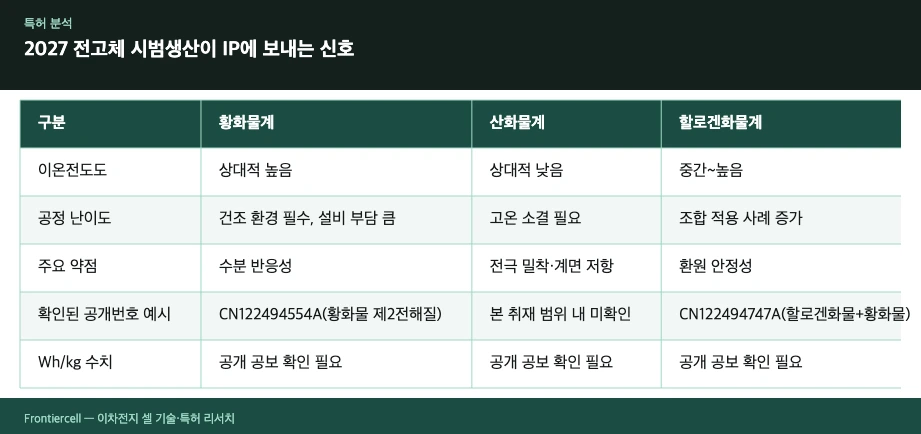
What this table tells us. Superiority among the families has not yet been settled, and actual filings are moving toward combination structures that mix families rather than a single family. The energy-density figures are left blank because confirmed primary sources do not provide them. Unverified Wh/kg comparison tables circulate widely in the industry, but figures without a source cannot serve as a basis for an FTO judgment.
④ Patent Perspective — Claim Gist and Design-Around Points
Six solid-state-related patents disclosed by BYD show fairly clearly where the scope of rights is headed. Of the six, four fall in materials chemistry and two in manufacturing/quality-control. What follows is a restatement of the gist of the published gazettes; the original text is not reproduced verbatim, nor are any drawings reproduced.
- CN122494747A: a configuration that places an ion-conductive interlayer between a halide-based electrolyte and a sulfide-based electrolyte to block direct contact between the two materials, citing improved cycle life as the effect.
- CN122494554A: a configuration combining a first solid electrolyte as a buffer layer with a second sulfide-based electrolyte. It proposes, as a safety parameter, that the heat release of the active-material layer must not exceed 117 J/g.
- CN122494567A: a dual-layer composite structure in which the inner layer consists of a single-crystal cathode plus solid electrolyte, and the outer layer of a polycrystalline cathode plus a different electrolyte.
- CN122494558A: a configuration that lowers resistance by mixing lithium-treated metal oxide/sulfide with the solid electrolyte.
- CN122494552A: a process that improves the solid-solid interface by distributing an ionic-liquid wetting agent in a gradient within the electrode layer.
- CN122494553A: sets a contact-ratio (Re) standard as a quality metric, requiring that 60% or more of a cathode particle’s perimeter be in contact with electrolyte particles.
Here is how to read the scope of rights. The first four are strongly composition-claim in character, leaving relatively wide room for a design-around; the latter two are numerically limited on process/quality parameters. Numerically limited claims look narrow in scope, but if a pilot line’s actual process window converges around that same vicinity, the exposure to infringement grows substantially.
Design-around scenario. Taking CN122494553A’s 60% contact-ratio standard as an example, the design-around directions split into three. First, not using the contact ratio itself as the control metric, and instead defining quality by a different physical quantity such as calendering pressure or interfacial resistance value. Second, changing the particle shape so that the definition no longer holds as perimeter contact but as face contact. Third, securing a separate numerically limited patent in a different range and using it as a cross-license card. In all three directions, however, the possibility that the doctrine of equivalents applies remains, so whether a design-around actually succeeds may vary by each country’s claim-interpretation practice.
This is where market share enters the picture. A 39.9% supply share is, in itself, negotiating leverage. In a relationship where a cell supplier delivers volume to an automaker, a patent dispute quickly turns into a supply-disruption risk, which increases the incentive to settle through cross-licensing rather than litigation. Market share does not change the outcome of a lawsuit, but it is likely to function as a force that keeps things from reaching litigation in the first place.
⑤ Limitations and Outlook
Pilot production is not mass production. According to confirmed reporting, CATL is targeting raising its Technology Readiness Level (TRL) from the current stage 4 to stage 7-8 by 2027, and views large-scale mass production at a scale of one million units a year as unlikely before 2030. Early application is also limited to vehicles priced at 250,000 yuan (roughly KRW 48 million) or above. The roadmap disclosed by management, including Chairman Robin Zeng and Chief Scientist Wu Kai, is itself staged.
An opposing scenario to the optimistic outlook. The 2027 pilot could hit a cost-and-yield wall, pushing the 2030 mass-production target back further. In that case, a more awkward situation arises from an IP standpoint: the term of already-filed patents keeps ticking down while no working revenue materializes, lengthening the stretch in which only portfolio-maintenance cost accumulates.
This overlaps with the domestic situation as well. According to The Elec, LG Energy Solution executive Kim Nam-ho noted that many Korean battery cell, materials, and component companies are running losses, so even a high tax-credit rate does no good when there is no tax liability to offset — and he requested that direct refunds be included in the domestic production incentive tax scheme. Kang Gyu-hyun, a division head at the Ministry of Trade, Industry and Energy, said the ministry’s position is to first push for inclusion in the production tax credit and then move to direct refunds in stages, and lawmaker Lee Yeon-hee has already introduced related legislation.
Strategic alternative. Rather than filing broadly across every family, it is more realistic to select the process parameters that will inevitably get fixed at the pilot stage and stake a narrow-but-deep claim on them — items such as contact ratio, heat release, and calendering conditions, whose values are necessarily set once the line is running. Numerically limited patents of this kind carry low maintenance cost while directly targeting a competitor’s line conditions, making them efficient as cross-license assets for a late entrant with limited capital.
Three grounds support this. First, two of the six actually disclosed patents are already in the form of numerically limited process/quality claims. Second, a pilot line is by definition the stage where process conditions get fixed into numbers. Third, in a market structure with a 39.9% share, a dispute is more likely to end in a license than in litigation, which increases the real-world effectiveness of a negotiating card.
Action item for planning and IP staff. Within this week, pull the list of “process parameters that will be fixed as numbers” from your own solid-state pilot plan, build a cross-reference table checking whether each item overlaps with the numerically limited ranges of the six publication numbers above, and run a first-pass FTO screen. Once a pilot is underway, the cost of a design change rises sharply.
The figures cited in this article are based on their respective primary sources; the final determination of patent registration status and the scope of rights may vary depending on each country’s examination and adjudication outcomes.