Carbon nanotubes (CNTs) build pathways for electricity inside an electrode with far less material than carbon black. That advantage, however, holds only ‘when the tubes remain long even after dispersion.’ This article reads the principle, comparative data, and a patent that fences off the dispersant.
① What’s the Topic
The competitiveness of CNT conductive additives is decided not by the conductivity of a single tube, but by whether its ‘length’ survives the slurry dispersion process. That is why rights in this field are densely staked out around dispersants and dispersed particle size rather than around the CNT itself.
Start with the industry situation. The cathode active materials of lithium-ion batteries generally do not conduct electricity well, so a conductive additive is mixed into the electrode to create paths for electrons. For a long time this role was played by carbon black, a spherical carbon particle. But a conductive additive is ‘dead weight’ that delivers no capacity, so if the same conductivity can be secured with a smaller amount, that much more active material can be added. This is where thin, long carbon nanotubes (CNTs) draw attention.
The tension lies in dispersion. CNTs tend to stick together and clump through strong van der Waals interaction between tubes, making it hard to maintain a stably dispersed state[4]. There are also experimental results showing that when strong mechanical dispersion is applied to break up clumped CNTs, the tubes are damaged and shortened, reducing conductivity and raising the percolation threshold — the content at which a conductive network begins to form[2].
So the question this article seeks to answer is this: Why can CNTs build a conductive network with a small amount, and to preserve that advantage in real electrodes, what must be managed — while steering around whose rights?
② Basic Principle — Stepping Stones vs. a Long Rope
Let’s compare electron flow inside an electrode to crossing a river. Carbon black is a set of stepping stones. Each stone is small, so crossing the river requires placing many stones close together, and every point where stones touch adds the resistance of stepping over. CNTs are a long rope. Just a few strands laid across can connect a long distance at once, tying multiple active-material particles together with lines. For the same weight, the rope can connect a far greater distance — that is the basic logic of CNT conductive additives.
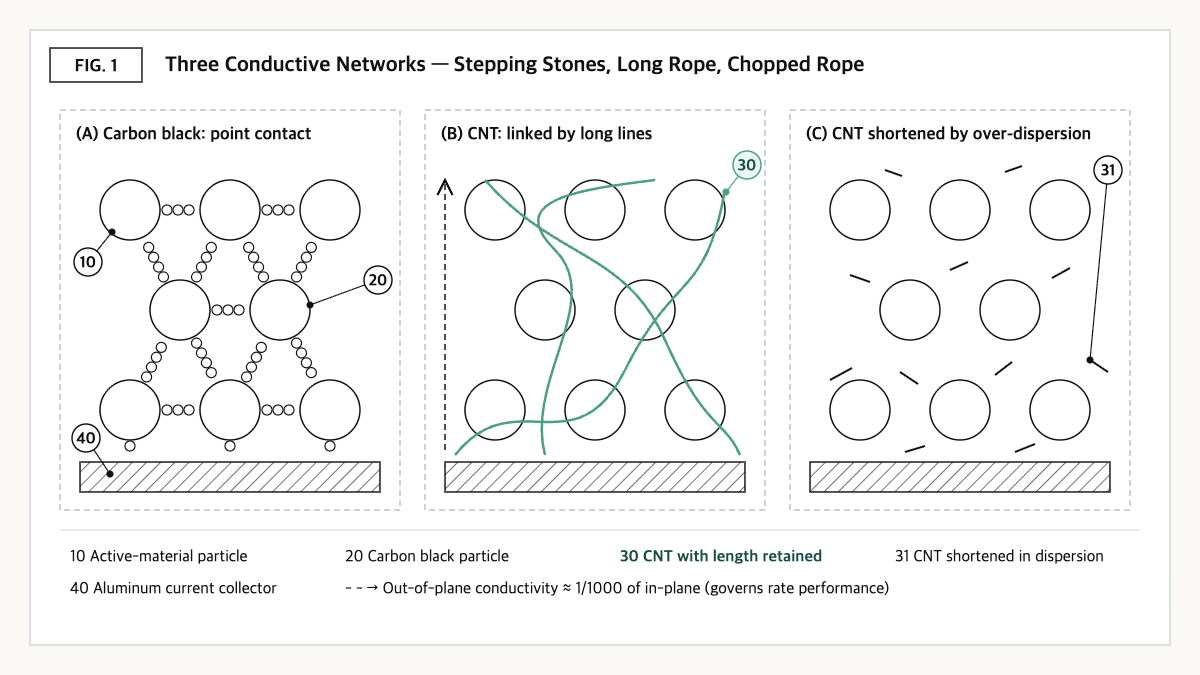
Source: reconstructed by the editorial team from the descriptions in Tian et al. (2019) and Lee et al. (2008).
There is one point that is easy to miss. An electrode’s conductivity differs greatly by direction. According to a study comparing NMC cathodes filled with carbon black, single-walled CNTs, and graphene, the out-of-plane conductivity, which matters most for charge/discharge rate performance, was roughly 1000 times smaller than the in-plane conductivity[1]. In the same study, conductivity rose with content for all fillers, but the nanotube-filled electrodes rose by far the fastest. The study also reported that once out-of-plane conductivity exceeds 1 S/m, the effect of electrode resistance on rate performance becomes negligible in almost all cases, and that this can be achieved with less than 1 wt% of single-walled CNTs[1].
Returning to the analogy, the value of a rope lies in its ‘length.’ If the rope is chopped into pieces during dispersion, it ends up no different from stepping stones. Indeed, in a study comparing multi-walled CNTs and carbon black added separately to graphite anodes, the CNTs were significantly damaged and shortened during dispersion, and the high-rate performance was not much different from that with carbon black[2]. Using CNTs means not swapping a material, but securing a process that untangles the tubes without breaking them.
③ Comparison — Carbon Black, CNTs, and Hybrids
| Item | Carbon black (CB) | CNT | CB + CNT hybrid |
|---|---|---|---|
| Shape and connection mode | Small spherical particles, point contact between particles (qualitative) | Thin, long one-dimensional tubes connecting particles in lines (qualitative) | CNTs handle long-range paths, CB handles short-range paths[3] |
| Conductivity increase with content | Rises with content but relatively gradually[1] | Rises fastest among fillers compared (single-walled CNT)[1] | Adding under 0.01 wt% super-aligned CNT film lowers percolation threshold and raises conductivity[3] |
| Representative reported values | — | Out-of-plane 1 S/m achievable with under 1 wt% single-walled CNT[1] | LiCoO2 cathode: 150 mAh/g at 0.1C, 99.7% capacity retention after 50 cycles / 87 mAh/g at 5C[3] |
| Main challenges | Hard to build long paths with small amounts (qualitative) | Van der Waals aggregation[4]; percolation threshold rises when damaged or shortened during dispersion[2] | Process conditions for two materials must be matched at once (qualitative) |
Source: reconstructed by the editorial team from Tian et al. (2019)[1], Lee et al. (2008)[2], Wang et al. (2013)[3], and the specification of US10686185B2[4].
What this table shows: Single-walled CNTs can clear the practical baseline of 1 S/m out-of-plane with less than 1 wt%[1], but if the tubes are shortened during dispersion, that advantage can shrink to the level of carbon black[2]. The decisive arena in conductive-additive competition is not the material grade sheet but the dispersion process.
④ Patent Perspective — The Fence Is Not Around the CNT but Around ‘How Hydrogenated the Dispersant Is’
In the CNT conductive-additive field, the rights that cell and material companies actually run into are often not the CNT substance itself but dispersion-liquid claims that define ‘with what, and to what degree, it was untangled.’ LG Chem’s US10686185B2 is a representative example. Priority date 2015-09-25, filing date 2016-08-26, grant date 2020-06-16, current assignee LG Chem, legal status Active (adjusted expiration expected 2037-02-02), with 11 granted claims[4]. The specification presents as its problem that with mechanical dispersion alone, such as ultrasonication, CNTs re-aggregate once treatment ends and aggregate as concentration rises[4]. Restated element by element, claim 1 reads as follows.
| Elements of claim 1 (restated) | Meaning for the scope of rights |
|---|---|
| (a) Comprising entangled-type CNTs | CNT form limitation — the boundary with other forms such as bundle-type may become an issue |
| (b) Comprising a dispersion medium | The type of dispersion medium is not limited in claim 1 — may be read broadly |
| (c) Comprising partially hydrogenated nitrile rubber (HNBR) whose residual double bond (RDB) value, defined as the weight ratio of conjugated-diene-derived units (BD) to the sum of BD and hydrogenated conjugated-diene-derived units (HBD), is 0.5–40 wt% | A limitation that fixes the dispersant’s ‘degree of hydrogenation’ by formula — the baseline for infringement judgment |
| (d) The D50 of the dispersed CNT particle-size distribution is 2–5 μm | Limits the dispersion state (the result) by a measurable value |
Source: reconstructed by the editorial team from the bibliographic data and claim structure of US10686185B2 on Google Patents (original claim language and drawings not reproduced verbatim).
The axis of the scope of rights is (c). Even among nitrile-rubber dispersants, a grade whose hydrogenation is nearly complete (RDB below 0.5%) or one with many remaining double bonds (above 40%) may fall outside the literal scope. Based on this, design-around scenarios can be sketched as (i) using a dispersant grade outside the RDB range, (ii) switching to a dispersant family other than nitrile rubber, (iii) adopting bundle-type CNTs, and (iv) designing the dispersed particle size D50 outside 2–5 μm.
Counterarguments must also be considered. (i) and (ii) may reduce dispersion stability, risking a return to the original problems of CNT shortening or re-aggregation. For (iv), D50 can vary with measurement conditions, so judgments may diverge near the boundary, and whether the doctrine of equivalents applies may also differ case by case. As a cross-check of similar patents, there is LG Chem’s own US11511994B2 (priority date 2018-07-27, granted 2022-11-29, Active). It claims entangled-type CNTs themselves with a pore volume of 0.95–2.0 cm³/g and a specific surface area of 200–300 m²/g, and by its title targets positive electrodes for primary batteries[5]. This can be read as the same applicant stacking ‘CNT properties’ and ‘dispersion-liquid composition’ into separate patents.
⑤ Limits and Outlook
On the optimistic side, the result that the 1 S/m out-of-plane baseline can be cleared with less than 1 wt% of CNTs[1] fits well with the design direction of reducing conductive-additive content and raising the active-material ratio. As electrodes get thicker, out-of-plane conductivity is likely to matter even more.
There is also a counter-scenario. The CNT advantage is a value measured under laboratory dispersion conditions, and under the high-concentration, long-duration mixing conditions of mass-production slurries, tube shortening could become more severe. In that case the dosage would need to increase, and the additional CNTs and dispersant could come back as higher slurry viscosity and cost burden. There is no guarantee that poorly dispersed CNTs deliver better results than carbon black[2].
As a strategic alternative, it is worth considering a role-sharing design between CNTs and carbon black rather than a switch to a single conductive additive. There are results showing that a hybrid approach — leaving long-range paths to a small amount of CNTs and short-range paths to carbon black — can lower the percolation threshold even with little CNT[3]. On the rights side, spreading the formulation may also be expected to reduce dependence on any specific dispersion-liquid claim.
Action to check (planning/IP teams): From the specification sheet of the CNT dispersion you use, confirm the CNT form (entangled/bundle), dispersant type and degree of hydrogenation (RDB), and dispersed particle size (D50), and compare them one-to-one with the numerical ranges of claim 1 of US10686185B2. If it is a supplier’s product, check the contract for licensing or warranty coverage regarding that patent.
Items Requiring Verification
- The Korean, Chinese, and European family members of US10686185B2 and their grant and maintenance status in each country were not separately checked in this article.
- Prices per kg of CNT and carbon black, and actual conductive-additive content in mass-production cells, could not be confirmed from public sources and were excluded from the comparison table.
- Tian et al. (2019) cited in this article is based on the arXiv version; whether figures changed in the later journal version was not checked.
Sources
- Ruiyuan Tian et al., “Quantifying the effect of electrical conductivity on the rate-performance of nanocomposite battery electrodes,” arXiv:1912.02485, 2019. Link
- Jin-Hyon Lee et al., “Comparison of multiwalled carbon nanotubes and carbon black as percolative paths in aqueous-based natural graphite negative electrodes with high-rate capability for lithium-ion batteries,” Journal of Power Sources 184(1), 308–311, 2008. Link
- Ke Wang et al., “Hybrid super-aligned carbon nanotube/carbon black conductive networks: A strategy to improve both electrical conductivity and capacity for lithium ion batteries,” Journal of Power Sources 233, 209–215, 2013. Link
- Google Patents, US10686185B2 “Carbon nanotube dispersion liquid and manufacturing method thereof,” bibliographic data, specification, and claim 1 (original checked 2026-09-23). Link
- Google Patents, US11511994B2 “Carbon nanotubes, method of manufacturing same, and positive electrode for primary battery comprising same,” bibliographic data and claim 1 (original checked 2026-09-23). Link
This article is a technology and patent trend commentary, not legal advice. Specific FTO judgments require professional review.
Related Reading
- How Slurry Dispersion Pressure Affects Cell Performance — Why 3,500bar Ultra-High-Pressure Dispersion Technology Is Getting Attention
- Electrode Tab Design — The Hidden Variable That Determines Internal Resistance
- Dry Electrodes: Remove the Solvent and the Binder Becomes the Bottleneck — The Material Constraint of PTFE Fibrillation