LiPF6, the standard salt in lithium-ion electrolytes, is vulnerable to moisture and heat, while LiFSI, often named as its alternative, corrodes the aluminum current collector of the cathode. Dual-salt design emerged because the two salts’ weaknesses lie on different axes, and that design has already come inside the fence of patents.
① What’s the Topic
Choosing a lithium salt is not a question of ‘which salt is better’ but of ‘what covers for one salt’s weakness.’ Because the weaknesses of LiPF6 and LiFSI do not overlap, mixing them or covering the weakness with an auxiliary additive is settling in as the realistic option, rather than abandoning one for the other.
Start with the industry situation. Lithium hexafluorophosphate (LiPF6) has long been the base salt of commercial electrolytes. Yet pure LiPF6 is thermally stable only up to 380 K (about 107°C) in a dry inert atmosphere, and it decomposes by dissociating into solid LiF and gaseous PF5. When moisture (300 ppm) is present, the decomposition onset temperature drops and POF3 and hydrofluoric acid (HF) form[1]. Recent research has also pointed to an oxidation stability of 4.2 V and a water tolerance of around 10 ppm as limits of commercial LiPF6 electrolytes[2].
Lithium bis(fluorosulfonyl)imide (LiFSI) sits on the other side. One patent specification states that LiFSI electrolytes have high conductivity, favoring rate and low-temperature performance, but that their use in batteries is limited by their metal-corrosion behavior[3]. Indeed, in LiFSI electrolytes aluminum corrosion has been reported to start at around 3.3 V at 45°C and to worsen as temperature rises[4]. Here lies the tension. Cathode current collectors are mostly aluminum foil, and the higher the charging voltage, as with high-nickel cathodes, the more this weakness may show. So the question this article answers is: what mechanism lies behind each salt’s weakness, and whose scope of rights covers the combinations that fill those gaps?
② Basic Principle — ‘Scale Armor’ and ‘Glue That Melts Away’
An aluminum current collector withstands high voltages thanks to a thin protective layer on its surface. If this protective layer is likened to armor, then what kind of armor the electrolyte’s anion puts on determines whether corrosion occurs.
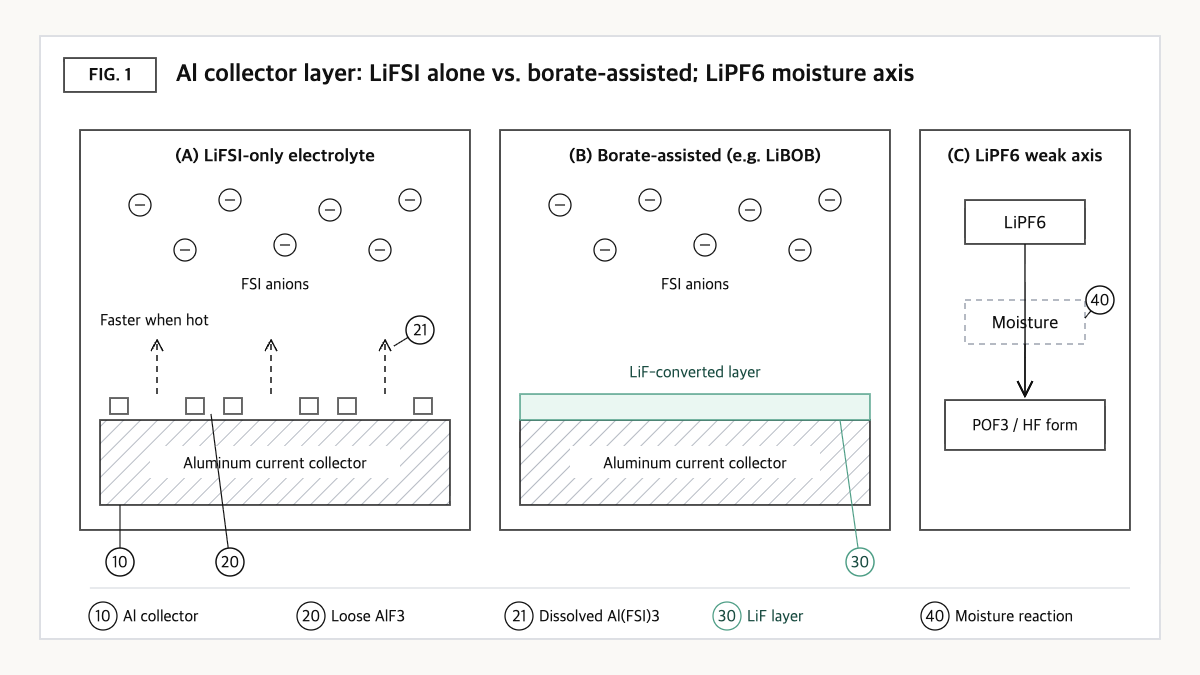
Source: reconstructed by the editorial team from the abstracts of Li et al. (2021) and Yang et al. (2006) and the US9698447B2 specification.
A paper studying the corrosion pathway of aluminum in LiFSI electrolytes identified two products: Al(FSI)3, formed when FSI anions meet aluminum, and aluminum fluoride (AlF3). The problem is that Al(FSI)3 dissolves into the organic solvent. Where it dissolves away, only loose, unprotective AlF3 remains, and corrosion actually accelerates. The dissolved aluminum ion (Al3+) concentration was 10.76 mg/L at 45°C, higher than 9.06 mg/L at room temperature[4]. By analogy, the glue holding the armor’s scales melts in the heat and the scales fall off.
The story changes when a boron compound steps in. In the same study, adding lithium bis(oxalato)borate (LiBOB) promoted the conversion of AlF3 into LiF and stabilized the interface[4]. Meanwhile, it has been noted that using LiPF6 together with LiFSI may passivate the metal, but with limited effect at high working voltages[3]. LiPF6’s weakness, by contrast, is not metal but water: HF formed by reaction with moisture attacks electrodes and interfaces[1]. In short, LiPF6 is ‘armor that is weak against water’ and LiFSI is ‘armor whose glue melts,’ and their weaknesses lie on different axes.
③ Comparison — Two Salts Whose Weaknesses Lie on Different Axes
| Axis of comparison | LiPF6 | LiFSI |
|---|---|---|
| Thermal behavior (dry inert atmosphere) | Stable up to 380 K (about 107°C), then dissociates into LiF + PF5[1] | Quantitative value not verified in this article (see Items Requiring Verification) |
| Moisture sensitivity | With 300 ppm moisture, decomposition onset drops and POF3/HF form[1] / Water tolerance of commercial electrolytes around 10 ppm[2] | Comparative data not verified |
| Aluminum current collector | May passivate when used with LiFSI; limited effect at high voltage[3] | Corrosion starts at around 3.3 V at 45°C and worsens at higher temperature[4] |
| Ion conduction / low temperature | Reference salt | High conductivity favors rate and low-temperature performance[3] |
| Mitigation examples | LiFSI 0.6M + LiBOB 0.4M dual salt: 134.3 mAh/g after 100 cycles, 8.4% loss (pure LiFSI failed within 20 cycles)[4] / LiFSI–LiPF6 dual salt: graphite∥NCM811 cells retained over 78% after 300 cycles at 60°C[5] | |
Source: reconstructed by the editorial team from Yang et al. (2006)[1], Zhang et al. (2024)[2], the US9698447B2 specification[3], Li et al. (2021)[4], and Kautz et al. (2026)[5].
What this table shows: LiPF6’s weaknesses cluster on the moisture/heat axis and LiFSI’s on the aluminum-corrosion axis. Accordingly, the reported improvements concentrate not on discarding one salt but on dual-salt approaches that add LiPF6 or a borate to cover each other’s weaknesses.
④ Patent Perspective — The Boundary Drawn by the Single Word ‘Asymmetric’
Designs that solve LiFSI’s corrosion problem with an auxiliary component have already been claimed. A representative case is US9698447B2 (title: Use of lithium bis(fluorosulfonyl) imide (LiFSI) in non-aqueous electrolyte solutions for use with 4.2v and higher cathode materials for lithium ion batteries). The original assignee is BASF Corp, and Google Patents lists Shenzhen Capchem Technology Co., Ltd. as the current assignee. Inventor Wentao Li; priority date 2013-11-18; filing date 2014-10-21; grant date 2017-07-04; 16 granted claims; legal status shown as Active (expected expiration 2035-04-01)[3]. Restated, claim 1 reads as follows.
| Claim 1 elements (restated) | Meaning for the scope of rights |
|---|---|
| (a) A non-aqueous electrolyte composition | Claims the electrolyte composition rather than the cell — electrolyte suppliers may also be direct targets |
| (b) Containing LiFSI as component a) | The independent claim does not limit LiFSI content or whether it is the main salt |
| (c) Containing, as component b), a compound selected from asymmetric borates, asymmetric phosphates, and mixtures thereof | Limits the type of auxiliary component — ‘asymmetric’ is required |
| (d) The weight ratio of b) to a) is about 0.2 to about 2 | Ratio limitation — scope defined by the amount of the auxiliary component relative to LiFSI |
Source: reconstructed by the editorial team from the Google Patents bibliographic data and original claims of US9698447B2 (checked 2026-09-23); original claim wording is not reproduced.
The example table in the specification is telling. Cells with the asymmetric borate LiDFOB mostly reached 4.2 V with no metal corrosion at the first discharge, whereas comparative examples with the symmetric borate LiBOB and with VC, FEC, and others are described as mostly failing to reach 4.2 V[3]. The insight to take here is that while academic literature reports aluminum-corrosion suppression even with the symmetric borate LiBOB[4], this patent places LiBOB among its comparative examples and claims only the ‘asymmetric’ type. The boundary of the scope of rights hangs on a single word: molecular symmetry.
Sketching design-around scenarios, the first paths that come to mind are ⓐ using a symmetric borate (LiBOB) and ⓑ designing the weight ratio below 0.2 or above 2. But the counterarguments are substantial. For ⓐ, the specification itself describes LiBOB as less effective, so the burden of proving performance may shift to the party designing around. For ⓑ, the outcome may depend on how broadly the claim’s ‘about’ lets the boundary values be interpreted. Moreover, because the independent claim does not limit LiFSI content, even an electrolyte using LiFSI only as a minor auxiliary salt could face a review of infringement risk if its ratio to LiDFOB falls within the range.
As a cross-check of similar patents, US5916475A from Hydro-Québec and France’s National Center for Scientific Research (CNRS) (title: Ionic conducting material having good anticorrosive properties; priority date 1994-03-21; filing date 1995-03-21; grant date 1999-06-29; 44 claims; Expired – Lifetime) advertises ‘anticorrosive properties’ in its title, but the substituent Y in granted claim 1 is limited to the phosphoryl type (POZ)[6]. However, separate independent claim 26 defines Y as sulfonyl (SO2) or POZ[6], so whether the sulfonyl-based FSI family falls within the literal wording of any claim must be read claim by claim. The case shows that the scope of rights should not be judged from claim 1 alone (this US patent has already expired).
⑤ Limits and Outlook
On the optimistic side, dual-salt electrolytes are likely to settle in as a practical solution that raises both life and safety. The basis is a report that a LiFSI–LiPF6 dual-salt electrolyte showed high-temperature life at 60°C, low-temperature operation, and suppressed heat evolution under overcharge conditions together[5].
There is also a contrary scenario. As high-nickel and high-voltage designs that raise the charging voltage to 4.2 V or above spread, pairing with LiPF6 alone may not passivate aluminum sufficiently, as the patent specification itself points out[3]. In that case, auxiliary components such as borates and phosphates become practically essential, and the likelihood that those combinations overlap the scope of in-force patents grows as well.
As a strategic alternative, it is worth recommending that lithium-salt FTO be managed as a three-factor matrix of ‘main salt + auxiliary component + relative ratio.’ A single salt may look like known art on its own, but narrowing down by ratio and combination can reveal zones that overlap in-force patents.
Action to check (planning/IP teams): In your electrolyte formulation, calculate the weight ratio of borate- or phosphate-type auxiliary components to LiFSI to see whether it falls within 0.2–2, and note in one line whether that component has an asymmetric structure (e.g., LiDFOB) or a symmetric one (e.g., LiBOB).
Items Requiring Verification
- Quantitative values directly comparable to LiPF6, such as the thermal decomposition onset temperature of the LiFSI salt itself, could not be verified against original documents in this work.
- The family composition of US9698447B2 in China, Europe, and elsewhere, and its grant status in each country, were not separately checked.
- The LiFSI content column for some cells in the example table could not be read during extraction from the original PDF, so it is not cited numerically in the text.
Sources
- H. Yang, G. V. Zhuang, P. N. Ross Jr., “Thermal stability of LiPF6 salt and Li-ion battery electrolytes containing LiPF6,” Journal of Power Sources 161 (2006) 573–579 (OSTI abstract). Link
- N. Zhang et al., “4.6 V Moisture-Tolerant Electrolytes for Lithium-Ion Batteries,” Advanced Materials 36 (2024), DOI 10.1002/adma.202408039 (OSTI abstract). Link
- Google Patents, US9698447B2 bibliographic data and original claims/specification PDF (checked 2026-09-23). Link
- C. Li et al., “Mechanism of aluminum corrosion in LiFSI-based electrolyte at elevated temperatures,” Transactions of Nonferrous Metals Society of China 31 (2021) 1439–1451. Link
- D. J. Kautz et al., “Advanced LiFSI-LiPF6 Electrolyte for Wide-Temperature and Thermally Stable Lithium-Ion Batteries,” Journal of the Electrochemical Society 173 (2026), DOI 10.1149/1945-7111/ae5348 (OSTI abstract). Link
- Google Patents, US5916475A “Ionic conducting material having good anticorrosive properties,” bibliographic data and claim 1 (original checked 2026-09-23). Link · Claim 26: Justia
This article is a technology and patent trend commentary, not legal advice. Specific FTO judgments require professional review.
Related Reading