If a ternary (NCM) cathode material is made not as a cluster of many small crystals but as a single crystal grain, the particles rarely split apart even under repeated charge and discharge. In exchange, part of the initial capacity and some freedom in the calcination process are given up. This article looks at that trade-off together with one patent that captured single crystals through “composition.”
① What’s the Topic
The core of single-crystal NCM is not that “cracks do not form,” but that “even if cracks form, no new surface opens.” And that benefit is not free; it is obtained by giving up part of the capacity and the calcination conditions.
Here is the industry context. For EV NCM cathode materials, the mainstream form has long been the polycrystalline secondary particle, in which primary particles a few hundred nanometers in size agglomerate to a few micrometers. Recently, single-crystal or single-particle cathode materials, in which one crystal is one particle, are frequently mentioned as an option for long-life cells.
The tension is the trade-off between life and capacity. In a study by researchers at the Technical University of Munich comparing polycrystalline and single-crystalline cathode materials of the same composition (NCM622), the specific surface area of the polycrystalline material increased up to about 6.5-fold relative to its pristine state at high state of charge, while that of the single-crystalline material barely changed[1]. On the other hand, the discharge capacity when charged to 4.5 V was 202 mAh/g for the polycrystalline material and 185 mAh/g for the single-crystalline material, lower for the single crystal[1].
So the question this article answers is this: what does a single crystal prevent and what does it give up, and where did a patent anchor this trade-off?
② Basic Principle — A Brick Wall vs. a Solid Stone: They Crack Differently
A polycrystalline secondary particle resembles a round wall built by stacking small bricks without mortar. NCM expands and contracts differently depending on crystal direction as lithium leaves and enters, and if each brick has a different crystal orientation, neighboring bricks push and pull on each other. This force concentrates at the boundaries between bricks, the grain boundaries, and cracks form. This is called an intergranular crack.
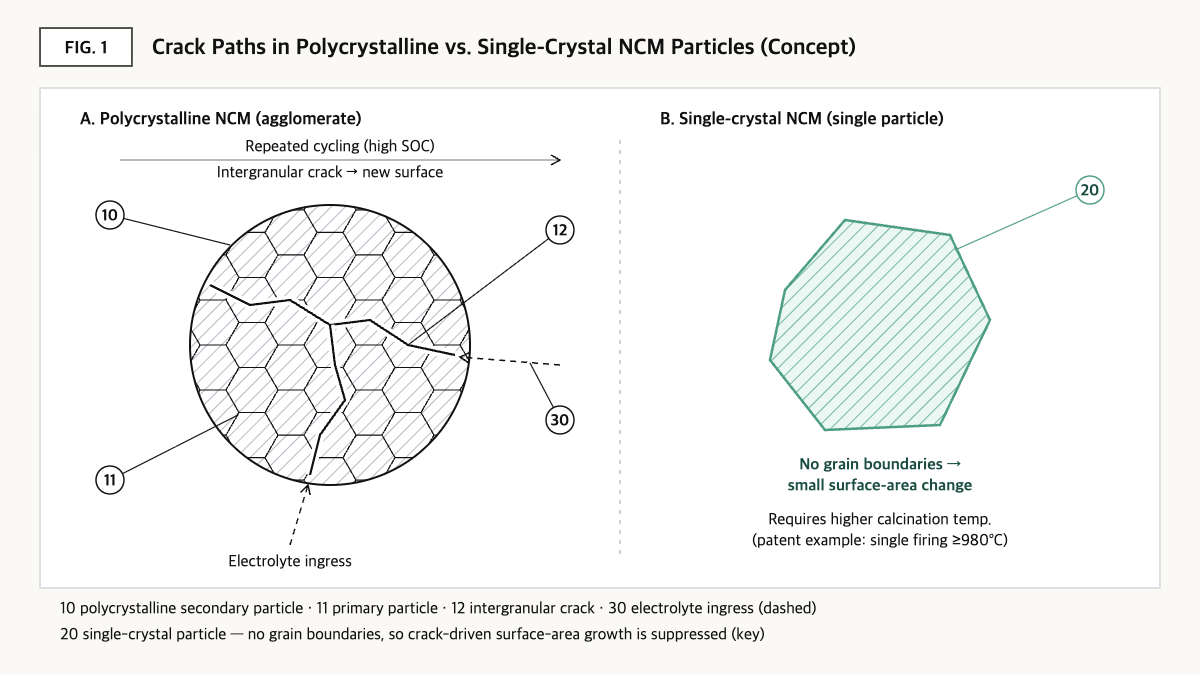
Source: reconstructed by the editorial team from Oswald, Bock, and Gasteiger (2022) and the US11973209B2 specification.
Electrolyte seeps into the cracked gaps. Brick surfaces that were hidden inside the particle then newly contact the electrolyte, and side reactions and gas generation occur on those new surfaces. The large increase in specific surface area of polycrystalline NCM622 in the study above is also interpreted as the result of electrolyte entering the crack gaps and widening the active surface[1].
A single crystal is closer to a sculpture carved from one solid stone. Since there are no boundaries between bricks at all, there is no place for intergranular cracks to form. In the same study, the cumulative oxygen and carbon dioxide gas over five cycles was 120 for the polycrystalline material and 56 for the single-crystalline material (relative values under identical measurement conditions), less than half, and the mass loss when heated to 325°C was also smaller for the single crystal: 1.59 wt% for polycrystalline versus 1.11 wt% for single-crystalline[1].
Then why doesn’t everyone switch to single crystals? To make a solid stone, the crystal must be grown large, which requires calcination (high-temperature heat treatment) at a higher temperature. High-temperature calcination requires managing side effects such as lithium volatilization[4], and the distance lithium must travel through the crystal also becomes longer. In the end, a single crystal is not a choice of morphology but a trade-off that adjusts calcination temperature, composition, and capacity all at once.
③ Comparison — The Same NCM622, Differing Only in Morphology
| Item (NCM622, same study conditions) | Polycrystalline (PC) | Single-crystalline (SC) |
|---|---|---|
| Initial specific surface area (Kr-BET) | 0.32 m²/g [1] | 0.27 m²/g [1] |
| Specific surface area change at high-SOC charging | Up to about 6.5x (vs. pristine) [1] | Essentially unchanged [1] |
| Discharge capacity (charged to 4.5 V) | 202 ± 3 mAh/g [1] | 185 ± 2 mAh/g [1] |
| Cumulative O2+CO2 gas over 5 cycles (relative) | 120 [1] | 56 [1] |
| Electrode mass loss when heated to 325°C | 1.59 wt% [1] | 1.11 wt% [1] |
Source: reconstructed by the editorial team from Oswald, Bock, and Gasteiger (2022), Journal of The Electrochemical Society 169[1].
What this table shows: The single crystal cut gas volume by more than half (120 → 56) and high-temperature mass loss by about 30%, but at the same 4.5 V charge its discharge capacity was about 17 mAh/g lower (202 → 185)[1]. The single crystal’s advantage lies not in “initial performance” but in “a surface that does not grow over time.”
④ Patent Perspective — Claiming Single Crystals Not as “Morphology” but as “an Easy-to-Make Composition”
As an example of capturing the single-crystal trade-off from the composition side, consider LG Chem’s US11973209B2 (title: Positive electrode active material including single particles of lithium nickel composite transition metal oxide…). The applicant and current assignee is LG Chem, with priority date 2018-06-07, filing date 2019-06-07, grant date 2024-04-30, legal status Active, and anticipated expiration 2041-11-05[2].
The specification cites as background problems the electrolyte side reactions caused by the large specific surface area of secondary-particle cathode materials, particle breakage during rolling, and gas generation from lithium by-products, and explains that if a specific composition is satisfied, single particles can be easily obtained with only a single firing at 980°C or higher[2]. It also states that when a precursor with less cobalt than manganese is used, it is difficult to make single particles even at the same sintering temperature and time[2]. Restating claim 1 element by element gives the following.
| Element of claim 1 (restated) | Meaning for the scope of rights |
|---|---|
| (a) A positive electrode active material for a secondary battery including a lithium composite transition metal oxide containing nickel, cobalt, and manganese | Product claim — the NCM family as a whole is the starting point |
| (b) A layered crystal structure of space group R-3m | A limitation met by ordinary layered NCM |
| (c) Nickel at 60 mol% or less of total transition metals | Mid/low-nickel limitation — high-nickel single crystals fall outside the literal scope |
| (d) Cobalt content greater than manganese content | Co > Mn relative-amount limitation — the key element tied directly to ease of single-particle formation |
| (e) Composed of single particles | Morphology limitation — the criterion for “single particle” could become an interpretive issue |
Source: reconstructed by the editorial team from the claim structure of US11973209B2 on Google Patents[2] (original claim language and drawings not reproduced verbatim).
The distinguishing feature of this claim is that it ties the single-crystal morphology to two composition conditions (nickel at 60% or less, cobalt > manganese). Had it claimed morphology alone, it would likely have run into prior art; by entering through the narrow window of “a composition that makes single particles easy to form,” it can be read as having traded a narrower scope of rights for better prospects of grant and a sturdier right.
Design-around scenarios (including counterarguments). (a) High-nickel single crystals with nickel above 60 mol% fall outside the literal scope of element (c). (b) Compositions with cobalt at or below manganese (low-cobalt, high-manganese) may also fall outside element (d). However, since the specification itself states that such compositions are difficult to form into single particles under the same conditions, the price of designing around may be raising the calcination temperature further or finding other process means (e.g., using a flux). (c) A bimodal design mixing single crystals and secondary particles could raise an issue regarding its relationship with element (e), “composed of single particles.” As a counterargument, it may be argued that the single-particle component within the mixture, taken on its own, satisfies the claim, so it is difficult to conclude that a mixed design is automatically a design-around.
Cross-check of similar patents. Samsung SDI’s US11777075B2 (priority date 2017-12-04, granted 2023-10-03, Active, anticipated expiration 2039-02-20) uses together secondary particles having radially arranged primary particles and a nickel-based positive active material of monolithic structure, coats both with cobalt, and limits the maximum surface roughness of the monolithic particles to about 15 nm or more[3]. This suggests that rights surrounding single-particle and monolithic particles may have formed on both the “standalone use” and “mixed use” sides.
⑤ Limits and Outlook
On the optimistic side, single crystals show clear advantages in gas, thermal behavior, and surface-area stability[1], so their adoption may widen in ESS where long life matters and in cells operated at high voltage.
There is also a contrary scenario. The result that the single crystal’s initial capacity is about 8% lower at the same 4.5 V charge[1] means that in applications where the life gain is not large enough to offset this capacity loss, single crystals could actually be at a disadvantage. The equipment and energy costs of high-temperature calcination, and the longer lithium diffusion distance inside the particle, also remain burdens for high-power applications.
The strategic alternative is to judge single-crystal adoption by “cumulative usable capacity per cycle.” Integrating the initial capacity gap and the life-extension effect over the same usage period reveals in which applications single crystals are practically advantageous. On the patent side, this article would add a perspective: because single-crystal patents are more likely to anchor their rights on the composition and calcination conditions that make single crystals possible than on the word “single crystal,” the first items to compare in an FTO review are not morphology but the composition table and calcination temperature.
Action to check (planning/IP teams): Check the nickel mole fraction and the cobalt-vs-manganese relationship of your own or your supplier’s single-crystal NCM, and first confirm whether it falls into the combination of nickel at 60 mol% or less with more cobalt than manganese.
Items Requiring Verification
- The dependent-claim structure of US11973209B2 (whether particle size, crystallite size, calcination temperature, etc. are included in the claims) and the Korean priority application number were not verified at the level of the original claims in this article.
- The comparison figures in the text are results of a single study on one composition, NCM622; whether the same trend appears at the same magnitude in high-nickel compositions requires separate verification.
- The gas figures (120, 56) are cited only as relative values under the original measurement conditions.
Sources
- Stefan Oswald, Moritz Bock, Hubert A. Gasteiger, “Elucidating the Implications of Morphology on Fundamental Characteristics of Nickel-Rich NCMs: Cracking, Gassing, Rate Capability, and Thermal Stability of Poly- and Single-Crystalline NCM622,” Journal of The Electrochemical Society 169, 2022, DOI 10.1149/1945-7111/ac5f7f. Link
- Google Patents, US11973209B2 “Positive electrode active material including single particles of lithium nickel composite transition metal oxide, method of preparing the same, and lithium secondary battery including the same,” bibliographic data and claim 1 (original checked 2026-09-23). Link
- Google Patents, US11777075B2, bibliographic data and claim 1 (checked 2026-09-23). Link
- Anqi Chen et al., “The Formation, Detriment and Solution of Residual Lithium Compounds on Ni-Rich Layered Oxides in Lithium-Ion Batteries,” Frontiers in Energy Research, 2020, DOI 10.3389/fenrg.2020.593009. Link
This article is a technology and patent trend commentary, not legal advice. Specific FTO judgments require professional review.
Related Reading