Lithium iron phosphate (LFP) prismatic cells for energy storage systems (ESS) are growing beyond 314 Ah into the 500 Ah and 600 Ah classes. This article explains what changes along with cell size, and what numbers patents are using to try to capture those changes.
① What’s the Topic
What changes when a cell gets bigger is not a single capacity number but the “ratios” inside the cell. How much electrolyte to hold relative to capacity, how much heat to remove, and whether to wind or stack the electrodes must all be recalculated.
Looking at the industry, LFP cells for ESS have moved from 280 Ah to 314 Ah and are now moving above 500 Ah. On a 20-foot container basis, systems of the 314 Ah cell generation are described as 5 MWh, and systems using 587 Ah cells as 6.25 MWh[1]. CATL announced mass production of a 587 Ah cell in June 2025, citing a volumetric energy density of 434 Wh/L[2], and EVE Energy announced plans to mass-produce its 628 Ah cell (Mr. Big) from December 2024[3].
The source of tension is also clear. According to a comparative analysis, a container of 587 Ah cells requires 80 kW of cooling capacity, more than the 60 kW for a 314 Ah cell container, and going beyond 587 Ah may run into weight constraints because of the 45-ton transport weight limit for 20-foot containers[1]. Another analysis notes that cells of 684 Ah and above are produced only by stacking (Z-stacking), and that larger cells are difficult to produce by winding[4].
So the question this article answers is: how do design challenges change when ESS LFP prismatic cells are scaled to the 300 Ah class and beyond, and which part of that are patents trying to capture?
② Basic Principle — Cooking Rice in a Bigger Pot
If you enlarge the pot to cook twice as much rice, simply doubling the rice and water is not enough. The time for water to soak between grains, the cooking speed at the center versus the edge, and the amount of steam escaping while it rests all change. Cells are the same.
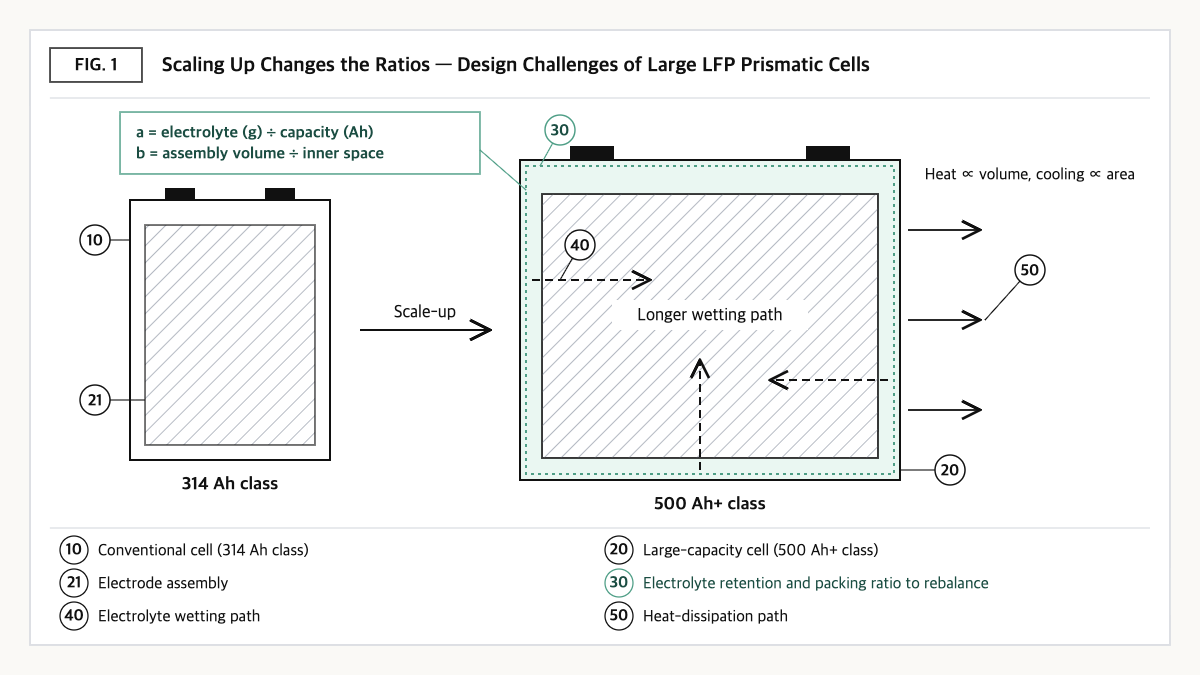
Source: reconstructed by the editorial team from Energy-Storage.News and EVreporter analyses and the definitions in US20250201835A1.
First is electrolyte wetting. As the electrode assembly grows larger and thicker, electrolyte takes longer to soak into the interior of the assembly, and the margin for electrolyte consumed over the service life must also be designed in. Yet adding more electrolyte increases weight and cost and reduces empty space inside the cell. Second is heat. Heat generation generally grows in proportion to volume, but the outer surface through which heat escapes grows more slowly, so the larger the cell, the less favorable the heat-dissipation conditions per unit volume.
The increase in container cooling capacity noted above illustrates this trend[1]. Third is the assembly method. Wound cells are made by winding long electrodes, and as cells grow, the constraints on winding width and length increase. The analysis that cells of 684 Ah and above are produced only by stacking reflects this constraint[4]. On the other hand, CATL announced that its 587 Ah cell has an inherent failure rate an order of magnitude lower than laminated cells, showing that the choice of manufacturing method has not yet settled in one direction[2].
This article’s perspective in one line: scaling up a cell is not “enlarging the same cell” but “re-balancing the ratios inside the cell.” Design metrics with capacity (Ah) in the denominator, such as electrolyte g/Ah, must all be recalculated each time the cell grows, and patents try to pre-empt exactly these ratios with numbers.
③ Comparison — The 314 Ah Generation and the 500 Ah+ Generation
| Cell (as announced) | Volumetric energy density | Announced cycle life | 20 ft container capacity | Assembly method |
|---|---|---|---|---|
| 314 Ah (industry 2nd generation) | 390–400 Wh/L[1] | Unclear in the original text | 5 MWh[1] | Not checked |
| CATL 587 Ah | 430–434 Wh/L[1][2] | 12,000 or more[1] | 6.25 MWh[1] | For the 587/588 Ah class, winding and stacking coexist in the industry[4] |
| EVE Energy 628 Ah | 386 Wh/L[1] | 8,000 (to 80% SOH)[1] | Up to 5 MWh (Mr. Giant)[3] | High-speed stacking (4th generation)[3] |
| CALB 684 Ah | 450 Wh/L (CALB product basis)[1] | 15,000 or more[1] | 6.9 MWh[1] | Stacking only for 684 Ah and above[4] |
Source: reconstructed by the editorial team from an Energy-Storage.News comparative analysis[1], coverage of CATL’s 587 Ah announcement[2], EVE Energy coverage[3], and an EVreporter analysis[4]. All values are based on manufacturer announcements or reports, not tests under identical conditions.
What this table shows: While cell capacity grew from 314 Ah to 587–684 Ah, 20-foot container capacity rose from 5 MWh to 6.25–6.9 MWh[1], but volumetric energy density is scattered from 386 to 450 Wh/L across cells. Enlarging a cell does not automatically raise energy density; design choices such as the assembly method determine the outcome.
④ Patent Perspective — An Application That Captures “How Much to Wet and How Much to Fill” in Numbers
One of the ratios that must be recalculated when scaling up cells is the electrolyte amount. An application that addresses this head-on is CATL’s US20250201835A1 (title: Battery cell, battery, and electrical device). The applicant is Contemporary Amperex Technology Co., Limited, and the current assignee is shown as Contemporary Amperex Technology (Hong Kong) Limited; the priority date is 2022-07-19 (Chinese application 202210854949.2), the international application is PCT/CN2023/105973 (2023-07-05), the US filing date is 2025-03-06, and the publication date is 2025-06-19. Its legal status is Pending (under examination)[5][6].
| Elements of published claim 1 (paraphrased) | Meaning for the scope of rights |
|---|---|
| (a) A housing in which an accommodation cavity is formed | Independent of cell form — not limited to prismatic |
| (b) An electrode assembly disposed in the cavity | No distinction between wound and stacked |
| (c) An electrolyte solution disposed in the cavity | A conventional liquid-electrolyte cell |
| (d) An electrolyte retention coefficient a (retained electrolyte amount ÷ first-cycle discharge capacity) in the range of 1.4–2.97 g/Ah | Key limitation — a numerical electrolyte range with capacity (Ah) as the denominator |
| (e) A packing fraction b (electrode assembly volume ÷ housing cavity volume) in the range of 80–99% | Numerical space-utilization range — combined with (d), limits the “wetting and filling” combination |
Source: reconstructed by the editorial team from the Google Patents bibliographic data and the published claims and definitions (specification) (original claim wording and drawings not reproduced). As an application under examination, the claims may change upon grant.
The dependent claims narrow the a/b ratio to 2.25–2.90, a to 1.8–2.3 g/Ah, and b to 85–95%, and include lithium iron phosphate among the positive active material options[6]. In other words, this application does not limit cell form or size; it tries to set the balance point between energy density and cycle performance through the combination of electrolyte amount per capacity and internal packing fraction. These are exactly the ratios that must be recalculated as cells grow.
Design-around scenario (with counterargument): Literally, designing a or b outside the published claim ranges may fall outside claim 1. There are two counterarguments, however. First, because the published ranges (1.4–2.97 g/Ah, 80–99%) are broad, ordinary designs may fall within them, so a design-around that shifts the numbers may come with a performance penalty. Second, conversely, the broader the ranges, the more room there may be for novelty and inventive-step challenges based on existing technology, so preparing opposition or invalidity arguments through prior-art searches may be a more realistic response than designing around. Also, under which conditions “retained electrolyte amount” and “first-cycle discharge capacity” are measured is likely to be at issue in infringement analysis, so a freedom to operate (FTO) review should also compare the measurement-method definitions in the specification.
Similar-patent cross-check: GS Yuasa’s EP4358220A1 (priority date 2021-06-29, publication date 2024-04-24) limits the lithium salt concentration of the electrolyte to 0.7 mol/dm³ or less in a cell using a lithium iron phosphate positive electrode and a carbon-based negative electrode such as graphite[7]. CATL’s application, which captures electrolyte by “amount (g/Ah),” and GS Yuasa’s, which captures it by “concentration,” are examples of protecting the electrolyte of the same LFP cell along different axes.
⑤ Limits and Outlook
Optimistically, 587 Ah-class cells are regarded as a “balance point” that holds 6.25 MWh within the 45-ton transport weight limit of a 20-foot container[1], so they may remain at the center of the ESS cell standard competition for some time. It is also noted that fewer cells mean fewer components and less wiring, simplifying system design[1][2].
There is also a counter-scenario. The larger the cell, the greater the impact when a single cell has a problem. The comparative analysis points out that very large cells may create more heat in localized spots and require more advanced cooling[1], and one assessment holds that cells of 684 Ah and above are not yet ready for 0.5C (2-hour) projects[4]. Cell enlargement is not advantageous under every operating condition.
The strategic alternative is to choose cell size to match the project’s charge/discharge rate (C-rate). According to the analysis, 587/588 Ah cells are being applied to 0.5C (2-hour) projects and cells of 684 Ah and above to 0.25C (4-hour) projects[4]. Using “the cell that fits the operating conditions,” not “the largest cell,” as the criterion makes it easier to balance cooling, weight, and service life.
Action to check (planning/IP teams): For large-capacity LFP cells under consideration, request electrolyte retention (g/Ah) and internal packing fraction data from suppliers and compare them with the numerical ranges of the published claims of US20250201835A1, and monitor the grant status and amended claims of this application and its Chinese counterpart every quarter.
Items Requiring Verification
- The Chinese and European counterpart application numbers of US20250201835A1 and their grant status were not checked. Claims may be amended during examination.
- Whether CATL’s 587 Ah cell is wound or stacked was not confirmed from official materials. The “failure rate versus laminated cells” in the text is a company announcement.
- The cycle life of the 314 Ah cell is not given because the notation in the cited article’s original text is unclear.
- The values in the comparison table are based on manufacturer announcements and reports, not tests under identical conditions. The publication date of the Energy-Storage.News comparative analysis could not be confirmed.
- The actual electrolyte retention (g/Ah) of each company’s cells could not be confirmed from public sources.
Sources
- L. Critchley, “Beyond 314Ah: A comparison of large-format LFP battery cells for BESS,” Energy-Storage.News (accessed 2026-09-23). Link
- “CATL Launches Mass Production of 587Ah Cell,” Battery Energy Storage System News, 2025-06-20 (citing the 2025-06-10 announcement). Link
- “Bigger batteries, better service: EVE Energy begins mass production of 600Ah+ energy storage cells this year,” Energy-Storage.News, 2024-10-30. Link
- R. Bollini, “Next Generation BESS Technologies using 392Ah / 587Ah / 684Ah LFP Cells,” EVreporter, 2026-07-14. Link
- Google Patents, US20250201835A1 “Battery cell, battery, and electrical device,” bibliographic data (original checked 2026-09-23). Link
- Justia Patents, US publication 20250201835 claims and related application data (checked 2026-09-23). Link
- European Patent Office, EP4358220A1 “Non-aqueous electrolyte power storage element,” publication document (checked 2026-09-23). Link
This article is a technology and patent trend commentary, not legal advice. Specific FTO judgments require professional review.
Related Reading
- The ESS War AI Data Centers Ignited — What the LFP Three-Way Order Race and the Third Central Contract Market Auction Reveal
- LFP vs. NCM: Not Better or Worse, Just Different Optimization Axes
- Three Paths for ESS Thermal Design — Air, Liquid, and Immersion Cooling: At Which Layer Do You Solve the Safety Standard?